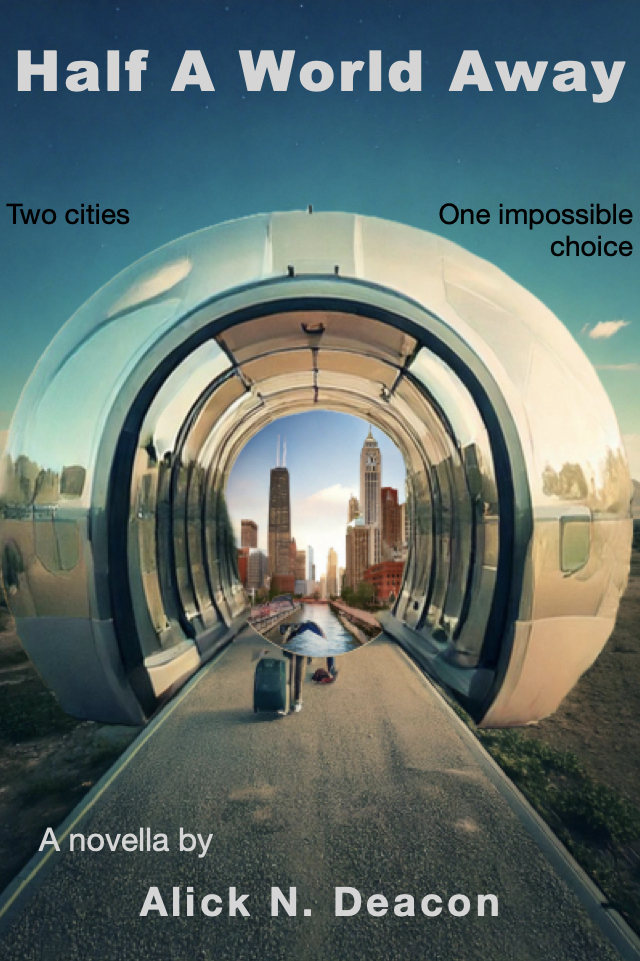
About Half A World Away
Half A World Away began with a question that had nothing to do with teleportation.
It started with a much simpler thought: if someone you loved needed you, and distance was the only thing standing in your way, how far would you go to be there?
Most of us live with the uncomfortable reality that we can't always be present for the people who matter most. Life gets in the way. Geography gets in the way. Sometimes timing gets in the way. The older I get, the more it seems that the most important moments in life have an alarming habit of ignoring our schedules.
From there, my imagination did what it usually does and started looking for ways to make the problem worse.
Teleportation seemed like the obvious answer. If distance is the obstacle, remove distance entirely. No traffic, no flights, no overnight stays in anonymous hotels. One moment you're here, the next you're on the other side of the world.
Problem solved.
Except, of course, it isn't.
One of the things that fascinates me about technology in fiction is that every solution creates new problems. Human beings are remarkably inventive when it comes to finding fresh ways to complicate their lives. Give us the ability to overcome a limitation and we'll immediately discover a consequence nobody anticipated.
The heart of Half A World Away became the collision between a deeply human need and a technology powerful enough to challenge our assumptions about reality itself. What begins as a personal journey gradually expands into something much larger, forcing characters to ask whether getting what they want is really worth the price of obtaining it.
As with much of my writing, the scientific idea wasn't the destination—it was the vehicle. The story was never really about teleportation. It's about family, loss, responsibility, and the choices people make when faced with impossible circumstances. The speculative elements simply allowed me to shine a brighter light on those very human struggles.
And besides, I've always enjoyed taking a seemingly sensible idea and following it to its logical conclusion until it becomes slightly terrifying.
Because if there is one lesson I've learned from writing speculative fiction, it's this:
The future rarely arrives with the problems you expect.