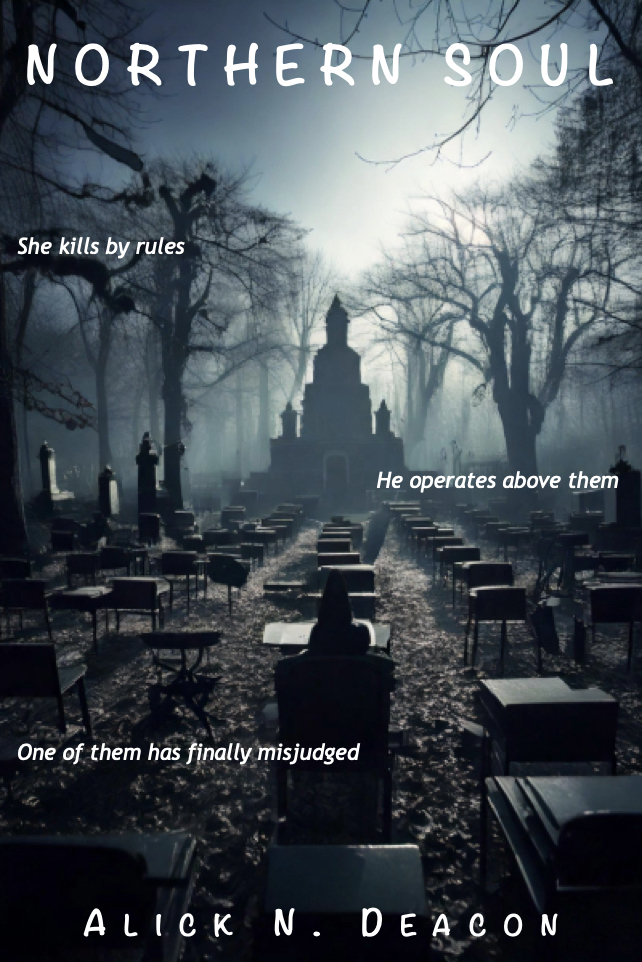
About Northern Soul
Northern Soul began with an uncomfortable observation.
Most fictional psychopaths are surprisingly easy to spot.
They're serial killers, criminal masterminds, shadowy conspirators, or otherwise occupied with activities that immediately identify them as the villain. The trouble is, many of the most damaging people in real life don't look anything like that. They wear suits. They run companies. They make strategic decisions. They sit in meetings and send emails while leaving a trail of damaged lives behind them.
That thought led me to wonder what might happen if two very different kinds of psychopath crossed paths.
On one side is Lucy Whitmore: quiet, reserved, fiercely private, and adored by her students. The sort of teacher parents hope their children will get. The sort of colleague people trust. She also happens to be a prolific serial killer.
On the other is Buchanan: charismatic, successful, influential, and entirely unapologetic. Unlike Lucy, he doesn't kill anyone. At least, not directly. Instead, he operates in a world of corporate power, intimidation, manipulation and privilege. He hurts people through systems rather than weapons, and he's spent most of his life convinced that success places him beyond accountability.
The more I explored that dynamic, the more interested I became in the contrast between them.
Lucy knows exactly what she is. She understands her darker impulses and spends much of her life attempting to contain them within a strict personal code. In her own way, she's fighting a constant battle against herself. Buchanan, meanwhile, sees no reason to fight at all. The rules that constrain other people simply don't seem to apply to him.
Neither would describe themselves as the villain of the story.
Which, of course, is precisely what makes things complicated.
One of the challenges of writing Northern Soul was resisting the temptation to simplify either character. The interesting question wasn't who was good and who was evil. It was how two people with profoundly different moral frameworks could arrive at the same point and regard each other as the real monster.
As the novel developed, it became less about violence and more about power.
Not power on a political or global scale, but the kinds that influence everyday lives: wealth, status, reputation, influence and the ability to act without consequences. Some people wield a knife. Others wield a boardroom.
Both can leave scars.
The COVID pandemic provided the perfect backdrop for exploring those themes. For perhaps the first time in living memory, almost everyone found themselves powerless at the same moment. Plans were cancelled, freedoms disappeared, routines collapsed, and certainty became a luxury. Against that backdrop, questions of control, responsibility and influence felt sharper than ever. The pandemic isn't merely a setting in the novel; it's the pressure that forces many of the characters to reveal who they truly are.
The title itself also carries its own dual meaning.
On the surface, it's a reference to the music that runs through the story. Northern Soul, and music more generally, becomes one of Lucy's grounding mechanisms—a way of keeping herself anchored when other aspects of her life threaten to spiral beyond control.
But the title is also a reflection of Lucy herself.
She is fiercely proud of her northern roots, and despite everything she has done—and everything she continues to struggle with—she is desperately trying to save what remains of her soul. The title captures both sides of her character: the cultural identity she embraces and the moral battle she fights every day.
Like many of my novels, Northern Soul began with a question and gradually evolved into something else. What started as an exploration of psychopathy became a story about privilege, accountability, loneliness, identity, and the uncomfortable reality that people can cause tremendous damage without ever considering themselves cruel.
Because one thing I discovered while writing the novel is that most people don't think they're crossing a line.
They simply convince themselves the line was never meant for them.