About In The Mean Time
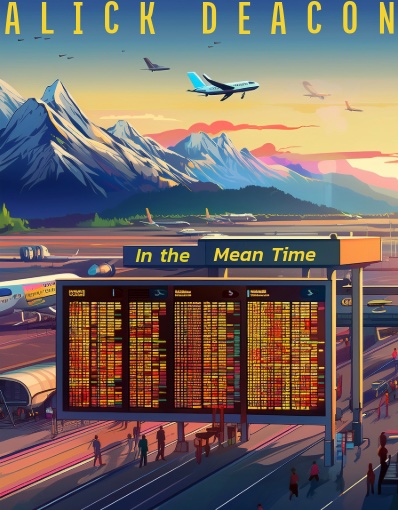
In the Mean Time is my fifth completed novel — though, like its predecessors, it has not yet found a home on bookshelves. Each book has been its own experiment: different tones, different genres, different thematic concerns. Yet running quietly beneath them all, linking these otherwise unrelated worlds, has been the same journalist appearing in cameo-like moments: Jack Hart. Sometimes he appears as a throwaway detail, sometimes as a lingering presence, but always as a signal that these stories, however stylistically distinct, belong to the same wider universe.
This novel is Jack’s origin story—the first time he steps out of the shadows of my earlier work and takes his place at the forefront. It ties all my previous books together while finally answering the question I’ve been circling for years: who is Jack Hart, and why does he drift so freely between these disparate worlds?
When Flight 63 vanishes over the Himalayas with 264 people aboard, journalist Jack Hart — a sceptic by profession and an outsider by temperament — is the last person anyone expects to uncover the truth. But when the official investigation stalls, Jack turns to the one person he has spent years avoiding: his estranged sister Jodie, whose ability to hear the dead has always been more curse than gift.
As they begin contacting victims of the crash, their findings reveal a deeper, more disturbing pattern: a mysterious passenger who doesn't appear on the manifest, a death that moves through the plane like a shadow, and a scientific anomaly that appears to reach beyond the limits of time itself. What begins as a journalistic enquiry becomes a fight for survival as Jack and Jodie realise that some truths don't want to be found, and some voices should never be answered.
In The Mean Time combines the emotional tension of The Leftovers, the investigative drive of Dark Matter and the uneasy, reality-tilting atmosphere of Arrival. It offers high-concept intrigue anchored by a strained sibling relationship at its core, and it explores the familiar world altered by just one technological step beyond what we currently understand.
Across my earlier manuscripts, I experimented with tone and genre: speculative mystery, supernatural suspense, political abstraction and literary character study. Each book taught me something essential about voice, structure and character — but for this project, I chose to return to to my creative roots. In the Mean Time is grounded sci‑fi: a world almost indistinguishable from our own, altered by just one speculative advancement with far-reaching, destabilising consequences.
The inspiration for this novel emerged from two parallel curiosities. The first was journalistic in spirit: a fascination with how truth is uncovered, distorted, weaponised, or buried. Journalists occupy a peculiar role in society — they chase the truth not only to reveal it, but to ensure that no one else gets to define it unchallenged. Jack Hart embodies both the nobility and the cost of that pursuit: his doggedness, his scepticism, his occasional self-sabotage, and the compromises he refuses to make even when the world insists he should.
The second curiosity was scientific. We live in a time where the boundaries between physical reality and theoretical possibility are dissolving faster than ever. Quantum models increasingly resemble philosophy. Technology routinely outpaces the ethics that seek to contain it. And the line between the measurable and the unimaginable is thinner than it has ever been. I became fascinated by the question: What happens when a small breakthrough in one of these areas occurs not inside a controlled lab, but inside the life of an ordinary, flawed family?
That 'one technological advance' became the backbone of the story, and Jack's estranged sister Jodie — whose ability initially looks supernatural and gradually reveals scientific implications — became the emotional centre. Their dynamic grew into the heart of the novel: two siblings divided by grief, ego and mistrust, forced back together by a mystery that neither can solve without the other. Their search for what happened aboard the doomed Flight 63 becomes, simultaneously, a search for what happened to them.
Though the novel includes high-stakes investigation, extreme environments and speculative science, it is ultimately character-driven. It's about the cost of needing the truth more than you need people; about the fear of inheriting what you never wanted; about the quiet corrosive guilt of surviving something you don't yet understand. Jack's journey in this book doesn't just reveal his past — it's sets the thematic tone for every story in this connected world: truth is messy, the unknown is frightening, and sometimes the answers we find end up transforming us more than the questions ever did.
Writing this novel has been an exercise in weaving together every lesson the earlier manuscripts taught me. Jack’s scattered appearances finally converge with purpose. Ideas I had introduced tentatively — suggestions of a larger pattern, hints of hidden symmetry — take on new meaning here. The universe behind my work feels coherent, intentional, expansive. Readers of my other books will recognise the connective tissue here; new readers can enter this story with no prior knowledge and still find a complete, self-contained narrative.
If my earlier novels were satellites, In the Mean Time is the gravitational centre that holds them in orbit.
Above all, In the Mean Time is a story driven by my enduring fascination with the unstable boundary between what we can prove and what we desperately hope is true. It is about the price of understanding, the fragility of certainty, and the quiet terror that sometimes accompanies knowledge we are not ready to possess.
And it is, I hope, the place Jack Hart finally becomes unforgettable.